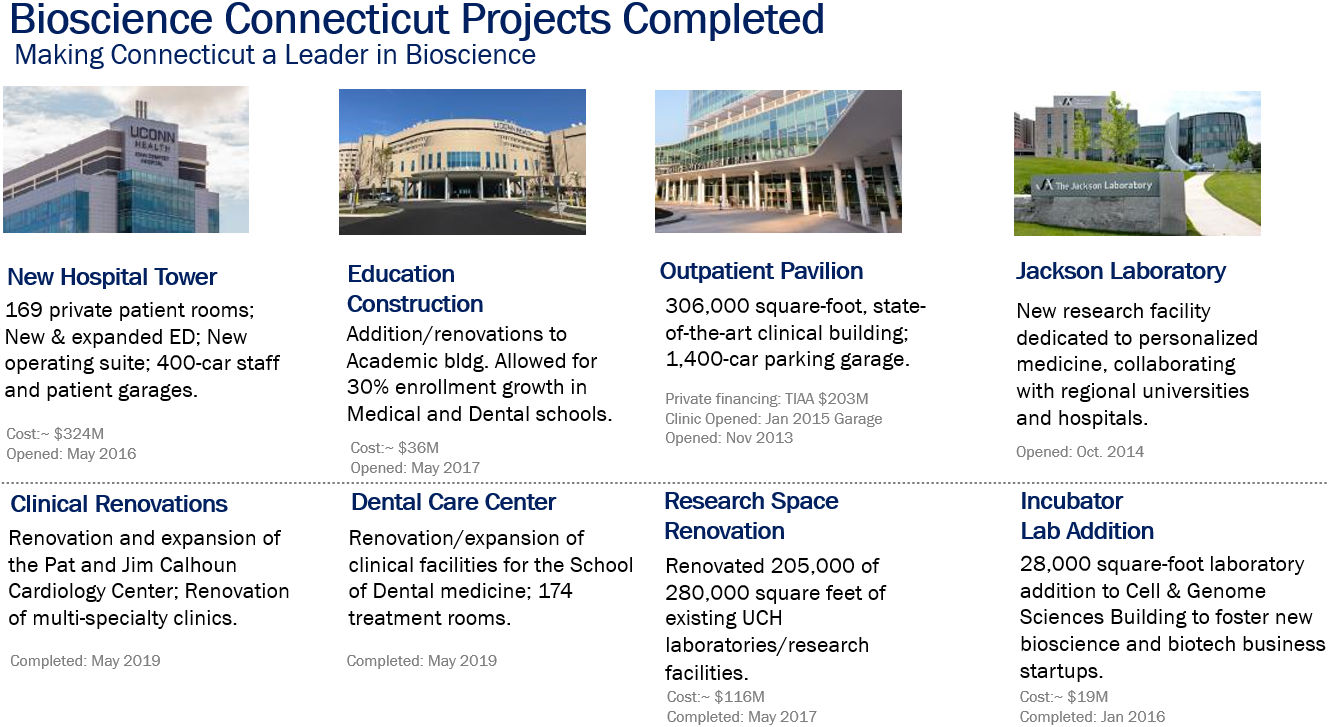
Bioscience Connecticut was an important component of the state's plan to jumpstart Connecticut’s economy by creating construction-related jobs immediately and generating long term, sustainable economic growth based on bioscience research, innovation, entrepreneurship and commercialization.
By becoming a leader in bioscience, Connecticut can again be at the forefront of an economic renaissance. By capitalizing on existing assets, and by attracting new ones, Connecticut can lead the new economy in a way that will make us an attractive place to do business, and a state that retains and attracts top-flight, national talent.
Gov. Dannel P. Malloy, May 17, 2011
About Bioscience Connecticut

Jobs Today, Economic Growth Tomorrow, Innovation for the Future
Bioscience Connecticut bolsters the state's vision to reinvent the Connecticut economy by harnessing the impressive research resources across our state and, at the same time, helps to secure UConn Health’s future as a top tier academic medical center. Elements of the plan include:
Bioscience Innovation
By renovating existing UConn Health facilities to increase research capacity and productivity, increasing the number of basic and clinical/translational scientists, and expanding incubator facilities to foster new business start-ups.
Improving Access to State-of-the-Art Health Care in Connecticut
By constructing a new hospital tower and ambulatory care facility, renovating the UConn John Dempsey Hospital and implementing several new community-based programs aimed at addressing pressing health care needs.
Return on Investment
The Bioscience Connecticut initiative at UConn Health was completed in 2018. The return on investment of this initiative can be measured by many metrics; here are some highlights:
- UConn Health served as the catalyst to the expansion of the bioscience industry in the region and state
- School of Medicine and Dental Medicine enrollment increased by 30%
- Increased access to patient care with an increase in patient volumes and unprecedented clinical revenue growth